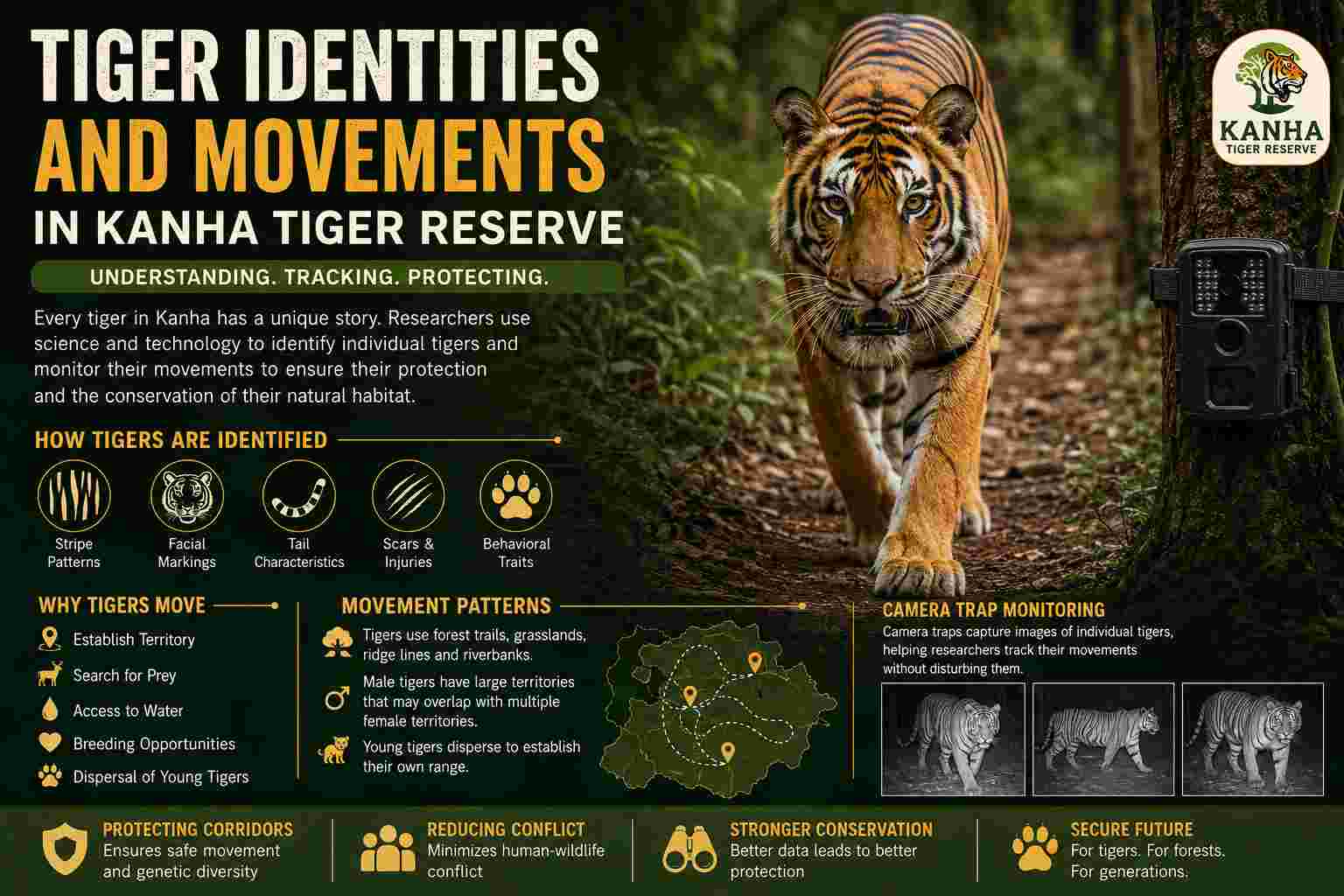
How Individual Tigers Are Identified
Tigers are the flagship species of Kanha Tiger Reserve and understanding their identities and movement patterns plays a crucial role in wildlife conservation. Every tiger living within the reserve has unique stripe patterns that allow researchers and forest officials to identify individuals and monitor their activities across the landscape.
Located in the Maikal Hills of Madhya Pradesh, Kanha is one of India's most successful tiger conservation landscapes. The reserve supports a healthy population of Bengal tigers and provides ideal habitat consisting of dense sal forests, bamboo thickets, open meadows, and perennial water sources.
Monitoring tiger identities helps wildlife managers understand population trends, breeding success, territorial behavior, and movement corridors, all of which are essential for long-term conservation planning.
How Tigers Are Identified in Kanha
Each tiger possesses a unique stripe pattern similar to a human fingerprint. Wildlife researchers use camera traps, photographs, and field observations to identify and catalog individual tigers throughout the reserve.
- Stripe Pattern Recognition
- Facial Markings
- Tail Characteristics
- Body Size and Structure
- Distinctive Scars or Injuries
- Behavioral Traits
These identification methods help build detailed profiles of individual tigers and allow authorities to track their movements over several years.
Why Tiger Movements Matter
Tiger movement is a natural ecological process that helps maintain healthy populations and genetic diversity. Understanding movement patterns allows conservationists to protect critical habitats and wildlife corridors.
- Territory Establishment
- Search for Prey
- Access to Water Sources
- Breeding Opportunities
- Dispersal of Young Tigers
Adult male tigers often occupy large territories that may overlap with several female territories, while young tigers travel considerable distances to establish new home ranges.
Tiger Territories in Kanha Tiger Reserve
Territorial behavior is one of the most important factors influencing tiger movements. Tigers regularly patrol their territories and mark boundaries through scent marking, scratch marks, and vocalizations.
Territory size varies depending on prey availability, habitat quality, and tiger density within the landscape.
| Tiger Category | Territory Range |
|---|---|
| Adult Male | Large Multi-Kilometer Territory |
| Adult Female | Smaller Territory Near Cubs |
| Sub-Adult Tiger | Temporary Dispersal Areas |
Camera Trap Monitoring and Tiger Tracking
Modern wildlife monitoring in Kanha National Park relies heavily on camera trap technology.
Motion-sensitive cameras installed across forest trails and waterholes capture photographs of tigers, enabling researchers to identify individuals and study their movement patterns without disturbing wildlife.
- Individual Tiger Identification
- Population Estimation
- Monitoring Breeding Females
- Tracking Dispersal Routes
- Anti-Poaching Surveillance
Wildlife Corridors and Safe Movement
Wildlife corridors are essential for maintaining connectivity between forest habitats. Tigers frequently move beyond reserve boundaries while searching for territory, mates, or prey.
Protected corridors help reduce conflicts with humans and ensure safe movement between different forest landscapes.
- Genetic Diversity Conservation
- Reduced Human-Wildlife Conflict
- Safe Dispersal of Young Tigers
- Habitat Connectivity
Conservation experts emphasize the importance of preserving these corridors to secure the future of tiger populations across central India.
Impact on Wildlife Tourism
Understanding tiger identities and movements also enhances wildlife tourism experiences. Visitors participating in Kanha Online Safari Booking often learn about famous resident tigers and their territories during jungle safaris.
Tracking information helps guides interpret wildlife behavior and increases awareness about conservation efforts within the reserve.
Conservation Measures in Kanha
| Conservation Activity | Purpose |
|---|---|
| Camera Trap Monitoring | Track Individual Tigers |
| Anti-Poaching Patrols | Prevent Illegal Activities |
| Habitat Management | Maintain Healthy Ecosystems |
| Corridor Protection | Enable Safe Tiger Movement |
Conclusion
Studying tiger identities and movements is fundamental to successful wildlife conservation. By tracking individual animals and understanding their behavior, forest authorities can make informed decisions that benefit both tigers and their habitats.
As one of India's premier tiger destinations, Kanha Tiger Reserve continues to set an example in scientific wildlife monitoring, habitat protection, and sustainable eco-tourism.
Visitors interested in exploring the reserve can check Kanha Jeep Safari Booking for safari permits, accommodation options, and guided wildlife experiences.
```